
Follow Us



Focus on the industry trends of PP hollow board and keep abreast of the latest product information of Henan Enda!
PP corrugated dividers are used for automotive components to separate individual parts, reduce part-to-part contact, and keep components organized during storage and transportation. Made from corrugated polypropylene sheets, these dividers are lightweight, moisture-resistant, and can be customized to fit different parts, boxes, totes, and returnable packaging systems.
For automotive suppliers, the right divider should do more than simply divide a box. Its cell size, sheet thickness, structure, and fit need to match the actual component and how it moves through the supply chain.
Automotive parts often have different shapes and surface requirements. When several components are packed together without internal separation, movement during transportation can cause scratches, dents, or unnecessary contact.
A PP corrugated divider creates individual compartments and keeps parts separated. This is useful for painted components, injection-molded plastic parts, metal stampings, lighting components, electronic housings, and other automotive parts that need organized packaging.
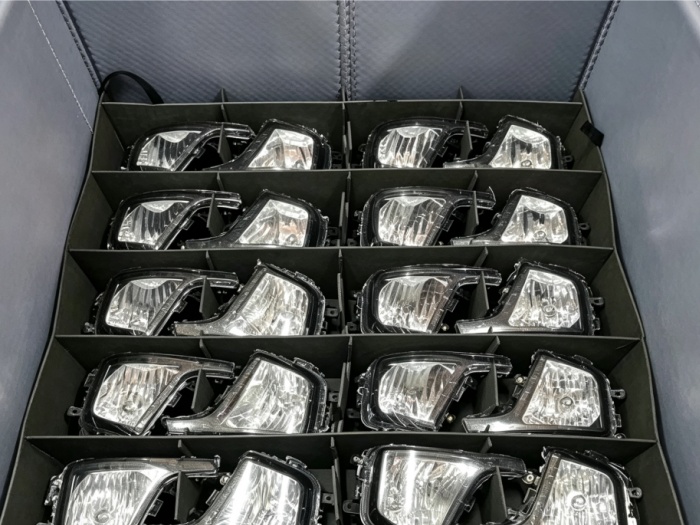 Automotive components packaging box dividers
PP is also resistant to moisture and easy to wipe clean, making corrugated PP suitable for reusable packaging and repeated handling. In returnable systems, dividers can be used inside totes or containers that circulate between suppliers, warehouses, and manufacturing plants.
The divider structure should be selected according to the shape, weight, and protection requirements of the component.
| Automotive Component | Recommended Divider Structure | Main Purpose |
| Plastic injection parts | Grid cells | Separation and organization |
| Metal stamped parts | Reinforced cells | Stability during handling |
| Painted components | Individual compartments | Reduce surface contact |
| Electronic components | Custom-size cells | Secure positioning |
| Irregular-shaped parts | Custom-cut structure | Better fit and separation |
| Small hardware | Multi-cell grid | Prevent mixing |
For parts with sensitive finished surfaces, the divider itself may also need a softer protective layer. The final packaging design should be tested with the actual components rather than selected only by material type.
There is no single PP divider thickness or cell size that works for every automotive component. The design should be based on several practical factors:
Component dimensions: Determine the required cell length, width, and height.
Component weight: Heavier parts may require thicker material or additional reinforcement.
Container dimensions: The divider should fit securely inside the existing carton, tote, or rack.
Cell quantity: The number of parts packed per container affects the overall layout.
Loading method: Cells should allow workers to load and remove parts without difficulty.
Reuse requirements: A divider used repeatedly may need a more durable structure than one used for one-way shipping.
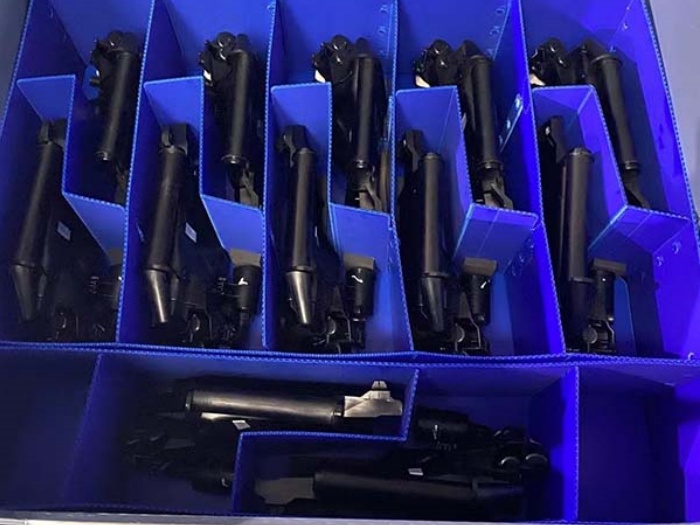 Choose the most suitable box divider
Cell size is particularly important. Oversized cells allow parts to move around, while cells that are too tight can slow down packing and make removal difficult.
For larger dividers, corrugation direction should also be considered because it affects the rigidity of the finished partition.
Cardboard dividers can work well for short-term or one-way packaging. PP corrugated dividers are more suitable when the packaging will face moisture, repeated handling, or regular circulation between facilities.
| Factor | PP Corrugated Divider | Cardboard Divider |
| Moisture resistance | Good | Limited |
| Repeated use | Suitable | Usually limited |
| Cleaning | Easy to wipe | More difficult |
| Structural durability | Good for repeated handling | More dependent on conditions |
| Returnable packaging | Well suited | Less suitable |
| Custom processing | Cutting, slotting, creasing | Cutting and folding |
The choice should therefore be based on the packaging cycle, not simply the initial material price. For a one-time shipment, cardboard may be sufficient. For a supplier-to-plant returnable system, reusable PP dividers can be a better fit.
Yes. Customization is one of the main advantages of using PP corrugated sheets for automotive packaging. Manufacturers can process the sheets according to the component and container dimensions.
·Common customization options include:
·Divider length and width
·Sheet thickness
·Cell dimensions
·Number of compartments
·Slot positions
·Cutting shape
·Color
·Printing or identification marks
·Conductive or anti-static PP hollow boxes and dividers based on the component type and application
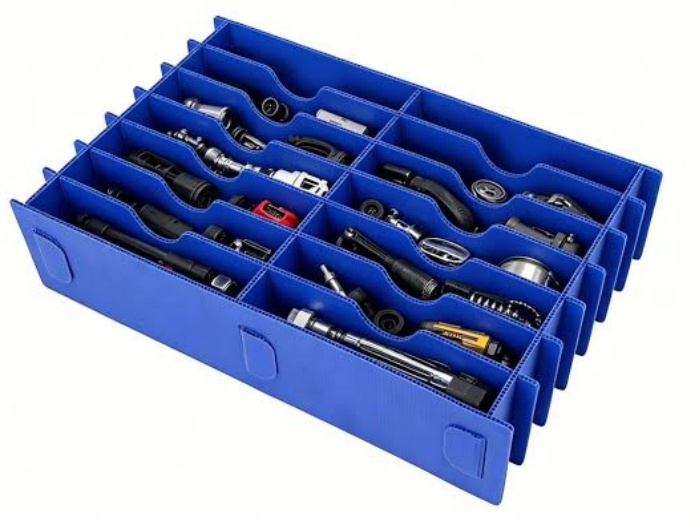 Customizable pp corrugated plastic box dividers
For a new project, buyers should provide the component dimensions, component weight, container dimensions, required compartments, and estimated order quantity. Drawings, photos, or physical samples can also help confirm the required structure.
A sample should ideally be tested with the actual automotive component before mass production. This can reveal problems with cell clearance, loading speed, or divider stability before the full order is manufactured.
Henan Enda New Material Co., Ltd. has accumulated more than 15 years of PP product manufacturing and export experience as of 2026, serving customers in automotive, industrial, logistics, and packaging applications.
We can process PP hollow board into custom corrugated dividers, partitions, and packaging inserts based on customer drawings and dimensions. Different sheet thicknesses, sizes, colors, and layouts can be considered for different automotive and industrial packaging requirements.
Whether you need a simple cross divider for plastic components or a multi-cell partition for returnable totes, the design can be developed around your actual packaging system.
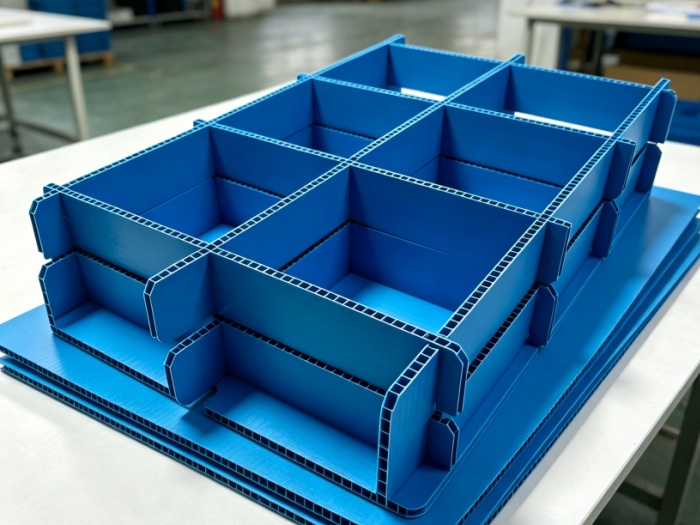 Henan Enda Compant supplies high quality pp plastic box divider
If you are sourcing PP corrugated dividers for automotive components, send us your component dimensions, container size, required cell layout, and order quantity. Our team can review the requirements and discuss a suitable divider structure.
Are PP corrugated dividers suitable for automotive packaging?
Yes. They can be used to separate automotive components during storage, transportation, and returnable packaging cycles.
What thickness should an automotive PP divider be?
There is no universal thickness. It depends on component weight, cell size, divider dimensions, and handling conditions.
Can PP dividers protect painted automotive parts?
They can help reduce direct contact between painted parts. For highly sensitive surfaces, an additional soft protective layer may be considered.
Can PP dividers be made conductive or anti-static?
Yes. Conductive and anti-static PP dividers and hollow boxes can be customized according to the component type and application requirements.

Reliable manufacturer of PP hollow board and corrugated plastic products with global reach.
Henan Enda
Copyright © 2019-2026.Henan Enda New Material Co., Ltd

